

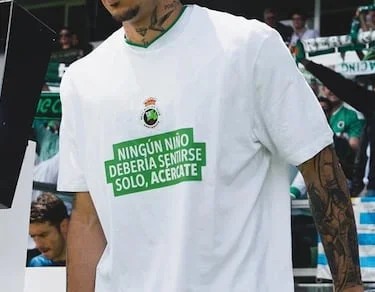
As Racing and Huesca players warmed up on the pitch and the crowd settled in for another thrilling LaLiga Hypermotion match, the voice of the legendary José Barba, announcer at El Sardinero, boomed over the loudspeakers: “Attention, we are looking for Omar’s parents. If you are his father or mother and you are here, please come forward. Repeat, if you are his father or mother and you are here, please come forward.” Some fans initially thought, “Where exactly? That’s vague…” Then the same voice repeated: “We are looking for Lucas’s older brother, Sara’s dance partner…” and a few sharp-eyed spectators realized, “This must be some kind of campaign.” Suddenly, the players took the field wearing shirts with the message: “No child should feel alone, come closer.” Bingo.
This was the latest initiative from the Racing Foundation, led by César Anievas, in collaboration with the club itself and the so-called “Project Victoria” (which ties football, education, and child protection). The goal was to draw attention to child vulnerability and its link to social exclusion.
“Racing 4 – Huesca 2: Passes and fails for Racing against Huesca: not even Dani Martín could stop them” and “Racing continues ticking off dates” are among the match coverage. But the real story was the pre-game message.
“The action focuses on the relationship between social exclusion and child vulnerability. Social exclusion limits access to basic rights like education, housing, or health. In Cantabria, more than 80,000 people live in this situation, a reality that directly impacts childhood,” the club explained.
“Child vulnerability, on the other hand, affects children and adolescents who grow up exposed to neglect, violence, emotional abandonment, or lack of adult role models. Both dimensions are deeply connected: growing up without protection increases the risk of exclusion in adult life, while environments of exclusion make it harder to access support networks and protection,” said the Second Division leaders.
